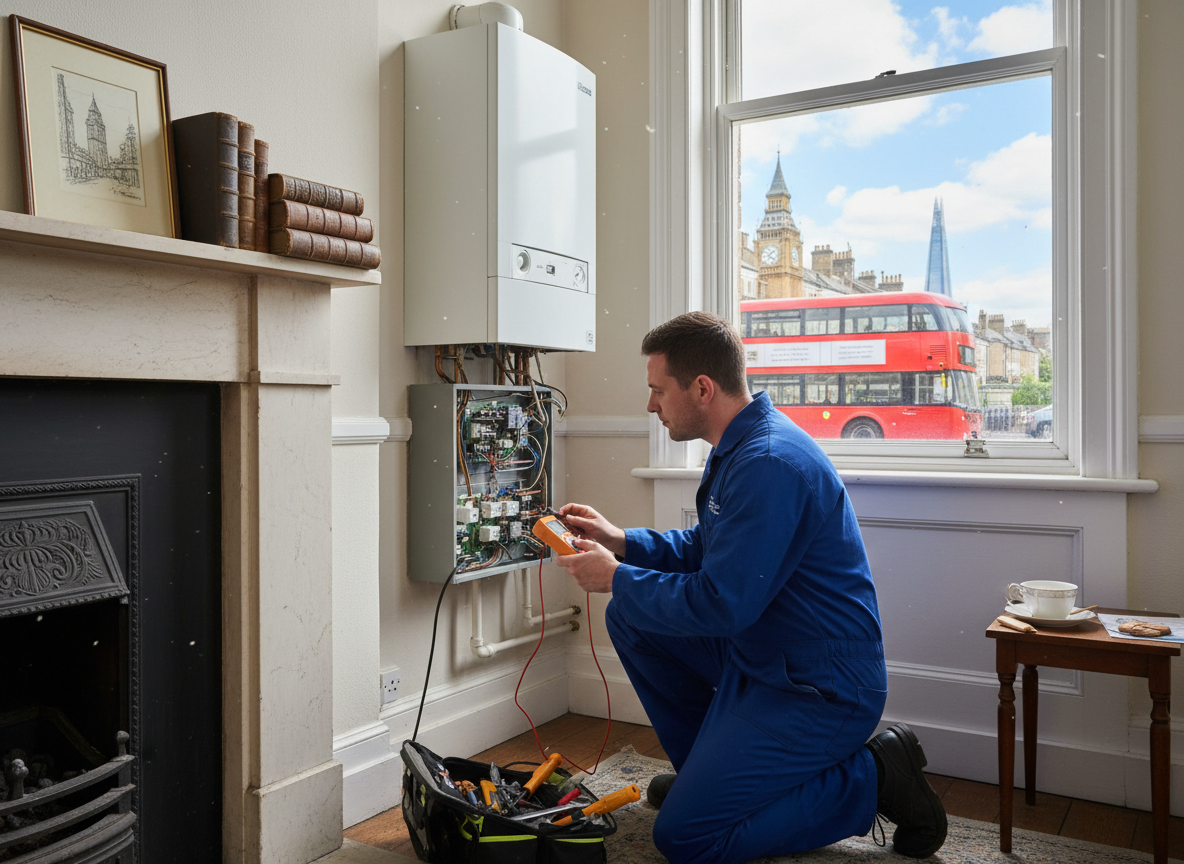
London's Victorian and Edwardian terraces in areas such as Southwark and Westminster often contain original wiring that struggles with modern electric heating loads. Damp winters combined with poor loft insulation mean storage heaters and panel systems work harder, leading to element failures and thermostat faults that require careful isolation before any work begins. Technicians must check consumer units for adequate capacity and earthing, especially in converted flats where multiple properties share risers.
Repair jobs frequently involve replacing failed night-storage heater bricks or faulty charge controllers that no longer respond to Economy 7 tariffs still common across Greater London. Access is usually tight in basement utility rooms or behind fitted cupboards, so compact tools and dust extraction are essential to avoid disturbing neighbouring flats. Any repair also includes verifying that the existing circuit cable size matches the heater rating to prevent repeated trips.
Edge cases include properties near the Thames where higher humidity accelerates corrosion on metal casings and connections. In these situations we isolate power at the main board first, then test for earth leakage before touching internal components. Replacement parts must match the original heater model because newer units often have different mounting points and airflow requirements that do not fit older recesses.
We always leave the system in a safe state even if full repair is declined, labelling any isolated circuits clearly for the homeowner. This approach prevents nuisance trips during cold snaps when demand spikes across the city grid.
Technician insight
In London, the thing that catches most people out with electric heating repair services is the amount of original cloth-insulated wiring still present in Southwark and Westminster terraces. One loose connection on an old ring main can turn a simple element swap into a full consumer-unit upgrade before the heater will run safely again.
Failed Storage Heater in a Westminster Conversion
A top-floor flat in a converted Victorian terrace near Westminster Bridge Road reported no heat from its night-storage unit during a cold snap. Inspection found a burnt-out element and degraded wiring at the isolator. We replaced the element, renewed the short run of cable to the consumer unit, and confirmed the circuit could handle the load without further trips.
How it works
- 1
Phone Assessment
Gather heater type, age, symptoms and property details to prepare the correct parts and tools before attending.
- 2
On-Site Isolation and Diagnosis
Isolate power at the consumer unit, test circuits, and identify the exact fault in the heater or controls.
- 3
Repair or Component Replacement
Replace elements, thermostats or controllers using compatible parts suited to the existing heater model and London wiring standards.
- 4
Testing and Handover
Restore power, run the heater through a full cycle, confirm safe operation and explain any ongoing maintenance points.
Pricing
Upfront quotes provided after initial diagnosis; final cost depends on parts required and access constraints in older London buildings.