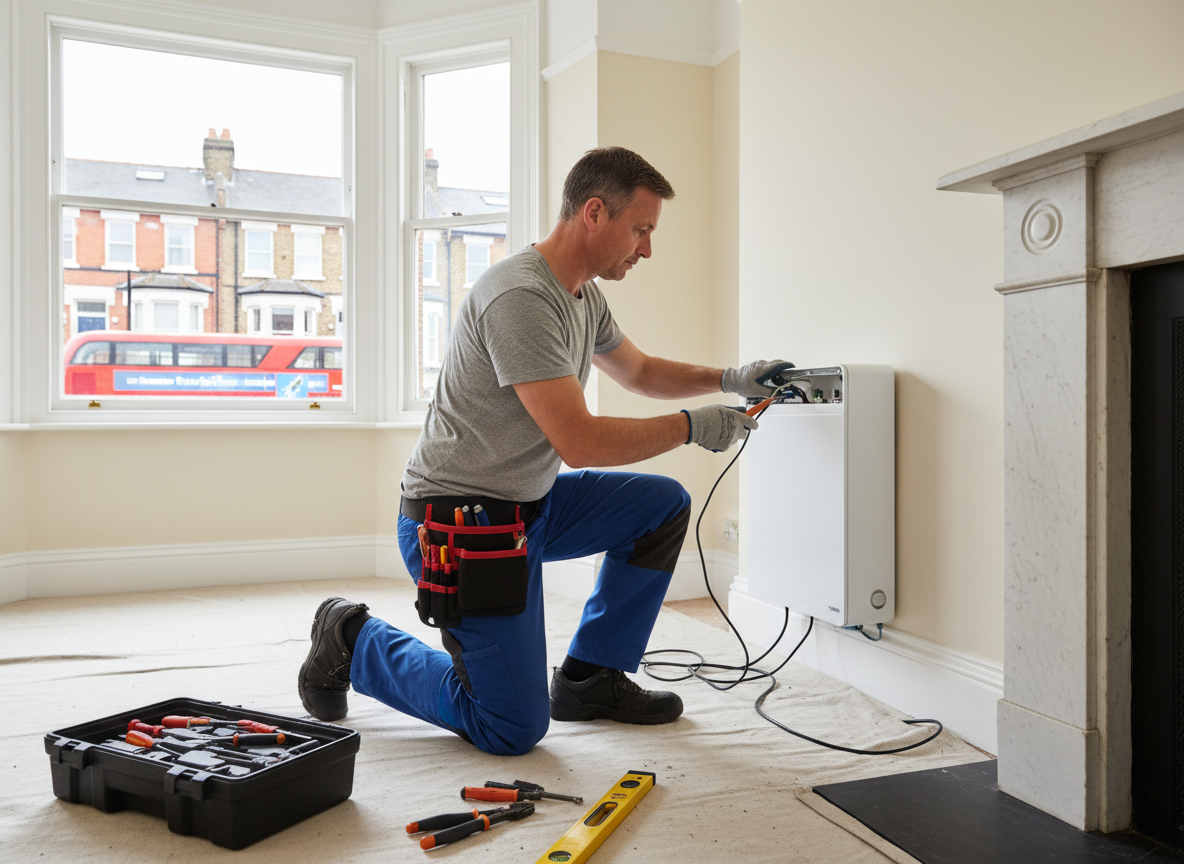
Electric panel heaters suit many London properties where gas is unavailable or impractical, especially in converted Victorian terraces around Westminster and Waterloo. Proper installation requires checking existing circuits, often 30-40 amp supplies in pre-1930s buildings, and ensuring units sit clear of furniture and curtains to meet Building Regulations Part P. We mount heaters on solid walls or use appropriate fixings for stud partitions common in SE1 conversions, then test for even heat distribution across the room.
London’s damp winters and occasional heavy rain increase condensation risks behind poorly placed panels. Installers must account for thermal bridging in solid brick walls and leave adequate clearance for airflow. In high-ceilinged Georgian and Edwardian flats near Westminster Bridge Road, we position heaters lower to create effective convection currents rather than letting warm air stratify at ceiling level.
Smart controls and timers are standard on modern panels, but older London wiring frequently needs upgrading before these can be added safely. We always isolate circuits at the consumer unit, verify earth continuity, and label new breakers clearly for future maintenance. Homeowners in multi-occupancy buildings must also confirm leaseholder permissions before any new fixed electric heating is installed.
Technician insight
In London, the thing that catches most people out with electric panel heater installer is the state of the original wiring in Victorian terraces around Westminster and Waterloo. Many properties still run on old ring circuits that cannot safely carry modern panel loads without a dedicated spur or consumer-unit upgrade, and damp solid walls make poor fixing points if you do not use the right anchors.
Westminster Conversion Overload
A client in a 1920s SE1 conversion kept tripping the main breaker when using portable heaters. We found the existing ring circuit was already near capacity. We ran a new 20A radial circuit from the consumer unit, installed three slimline panels on internal walls, and programmed daily timers. The system now runs without trips and maintains steady temperatures through the damp winter months.
How it works
- 1
Site Assessment
We inspect the property’s consumer unit, wiring routes and wall construction at your London address to confirm suitability for panel heaters.
- 2
Circuit Preparation
Existing circuits are tested and upgraded where needed to handle the load, particularly in older SE1 and Westminster buildings.
- 3
Mounting and Connection
Panels are fixed at the correct height and wired directly to the consumer unit or a dedicated spur with appropriate isolation.
- 4
Testing and Handover
Full function tests, timer programming and safety checks are completed before demonstrating operation to the client.
Pricing
Prices vary by number of heaters, circuit upgrades needed and access in older London buildings; we provide clear written quotes after the initial survey.