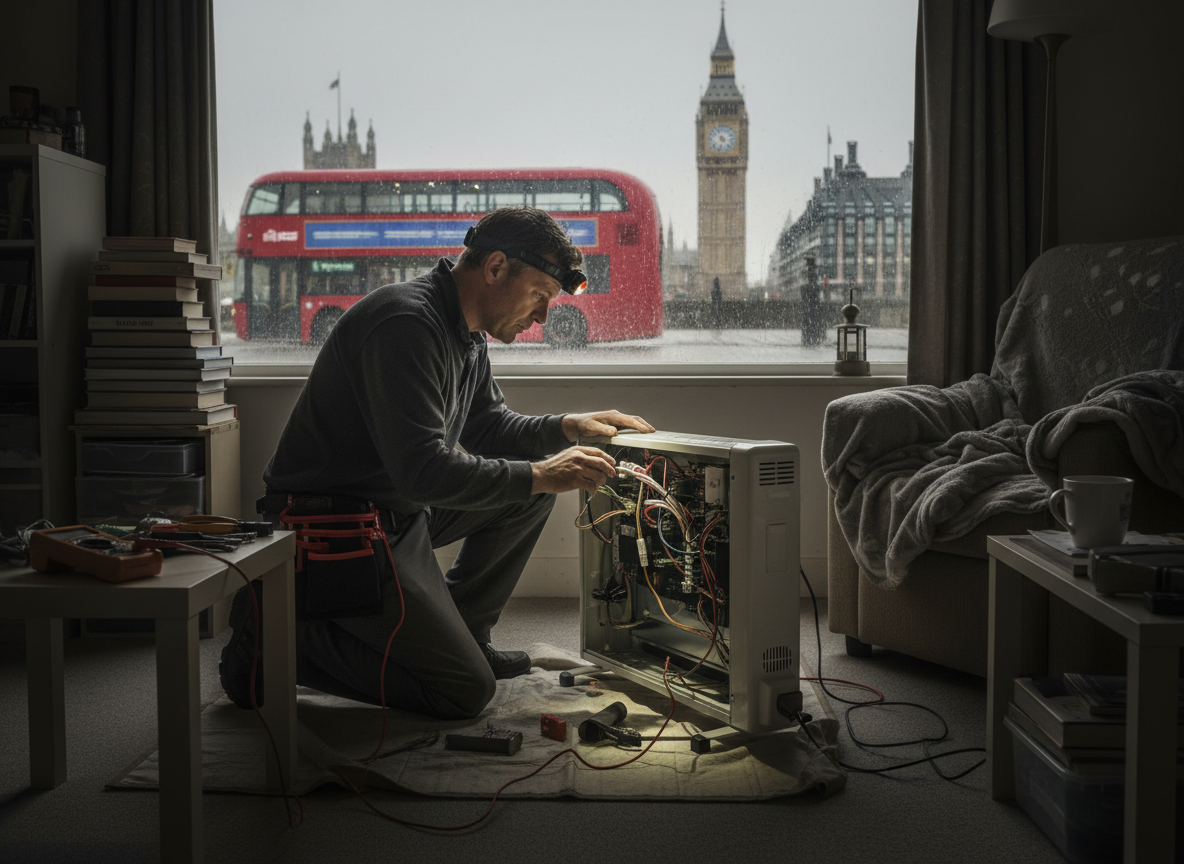
London's older housing stock, particularly Victorian and Edwardian terraces in Westminster and SE1, often features original wiring that struggles with modern electric radiator loads. Damp conditions common near the Thames accelerate corrosion on connections and thermostats, turning minor faults into full outages during winter cold snaps. A seasoned installer checks not just the radiator but the circuit integrity back to the consumer unit, watching for shared neutrals or overloaded spurs that are frequent in converted flats.
Edge cases arise when radiators are hardwired into lighting circuits or when properties have had multiple amateur additions over decades. Replacing a failed element requires isolating the correct breaker and confirming RCD protection, because many pre-1980s installations in central London still lack it. Skipping this step risks repeated failures or tripped boards elsewhere in the building.
Technicians carry common spares like capillary thermostats, simmerstats and replacement elements sized for standard 1.5kW and 2kW units found locally. They also test for earth continuity and insulation resistance before re-energising, because soil moisture around basement flats can migrate into wall chases and create tracking faults that only appear under load.
Technician insight
In London, the thing that catches most people out with emergency electric radiator repair is the amount of old rubber or lead-sheathed cable still hiding behind skirting boards in Westminster terraces. One loose neutral on a shared circuit can make a simple element failure trip half the flat, and the damp from the river makes those joints corrode faster than anywhere else in the country.
No Heat in Westminster Flat
A top-floor flat near Westminster Bridge Road lost all output from its electric radiator during a January cold spell. Investigation showed a failed thermostat and high-resistance joint on 1960s wiring run in a damp chase. The joint was remade, a new thermostat fitted and the circuit retested for earth continuity before handover.
How it works
- 1
Call and Triage
Answer the 24/7 line, confirm location in London and symptoms, then dispatch the nearest van from the SE1 base.
- 2
On-Site Safety Check
Isolate power at the consumer unit, verify circuit condition and inspect the radiator for visible damage or overheating signs.
- 3
Fault Diagnosis
Test element resistance, thermostat operation and wiring integrity to pinpoint the exact failure point.
- 4
Repair or Replacement
Fit the required part, re-terminate connections and restore power while monitoring for correct operation.
- 5
Final Verification
Run the radiator through a full cycle, confirm even heat output and leave the system safe for continued use.
Pricing
Upfront quote given on site before any parts are fitted or work proceeds.